News
CMCR Event Recap: Professor Jörg Matthes Gives a Talk on AI and the Future of Knowledge Production in Communication Research
28 Apr, 2026

The Centre for Media and Communication Research at the School of Communication, Hong Kong Baptist University, hosted a talk led by Professor Jörg Matthes from the University of Vienna on April 28, 2026. Professor Matthes, a leading communication scholar and editor of Communication Theory, delivered a talk titled “Team Member, Tool, or Troublemaker? AI and the Future of Knowledge Production in Communication Research.” The talk was moderated by Professor Yuner Zhu from the Department of Interactive Media at HKBU.
The talk centered on five key paradoxes of AI in research: AI brings us more insights yet less certainty; AI can either reinforce mainstream research norms or completely disrupt them; AI seems capable of replacing researchers, yet it still fundamentally needs human researchers; AI makes the research process faster yet it also makes scholarly work far more complex; AI creates a sense of artificiality in research outputs, but sometimes more real than reality.


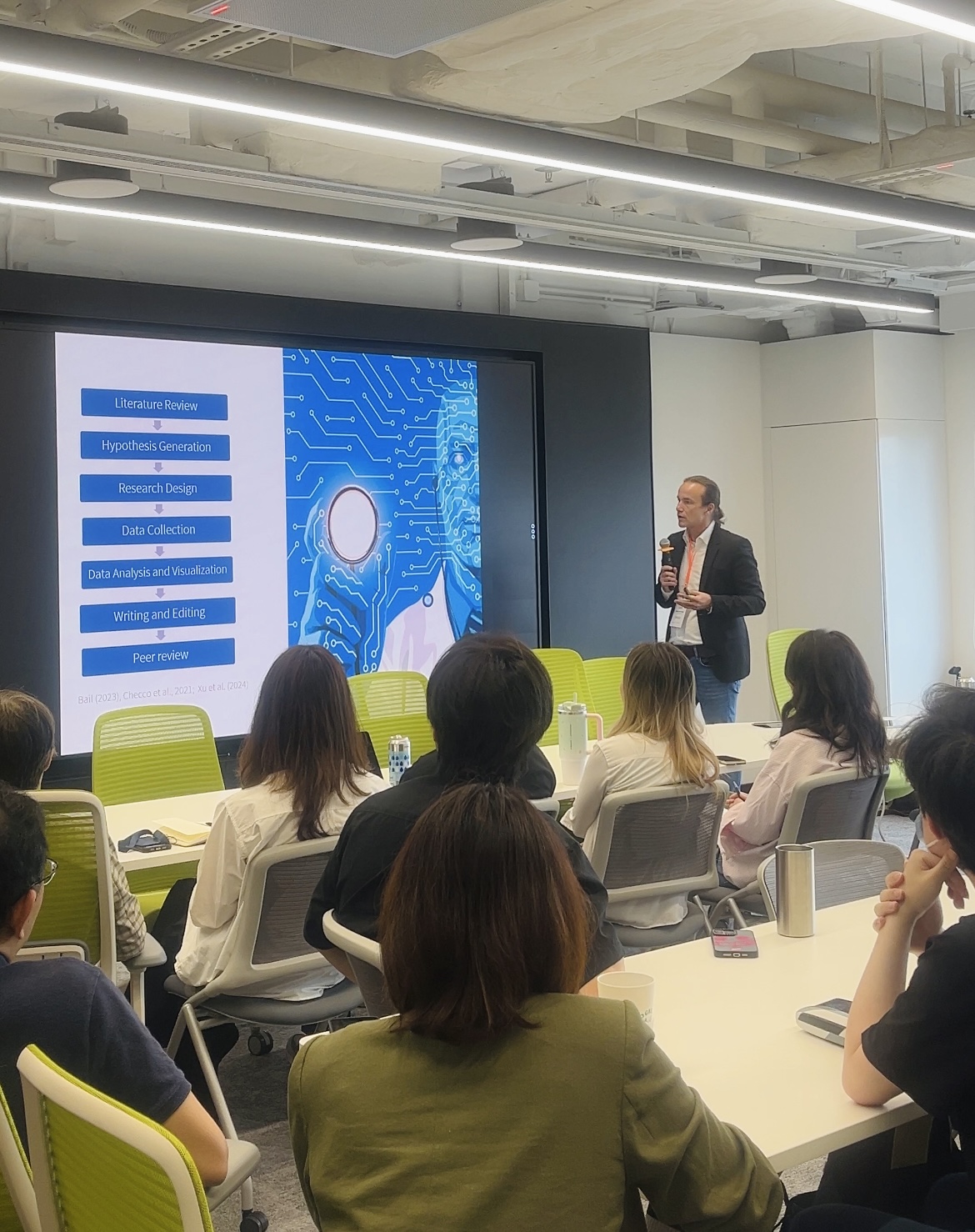
In his talk, Professor Matthes mapped generative AI’s full integration into the research cycle: literature review, hypothesis generation, research design, data collection, data analysis and visualization, writing and editing, and peer review. Drawing on concrete examples, he noted that AI greatly boosts efficiency in summarization, questionnaire design, qualitative coding, data visualization, and academic writing, yet brings critical flaws including fabricated references, bias amplification, limited innovation and lack of transparency.
In the face of the paradoxes of AI in research, Professor Matthes proposed three critical questions for responsible AI use: whether researchers can complete the task independently, whether AI use is fully transparent, and whether AI advances creative innovation, instead of acting as a passive lookup tool or a lazy shortcut. He emphasized that AI cannot replace human creativity, contextual judgment, causal reasoning, and original theoretical insight. He also addressed the need for establishing clear AI usage guidelines and upholding scholarly integrity.
Professor Matthes concluded that generative AI should be viewed as a collaborative partner rather than a replacement for human researchers. His key message was clear: AI should be used to expand our thinking, not replace it.

