News
CMCR Hosts Research Seminar by Professor Matthew Zook on AI, Bias, and Geographic Inequality
22 Dec, 2025
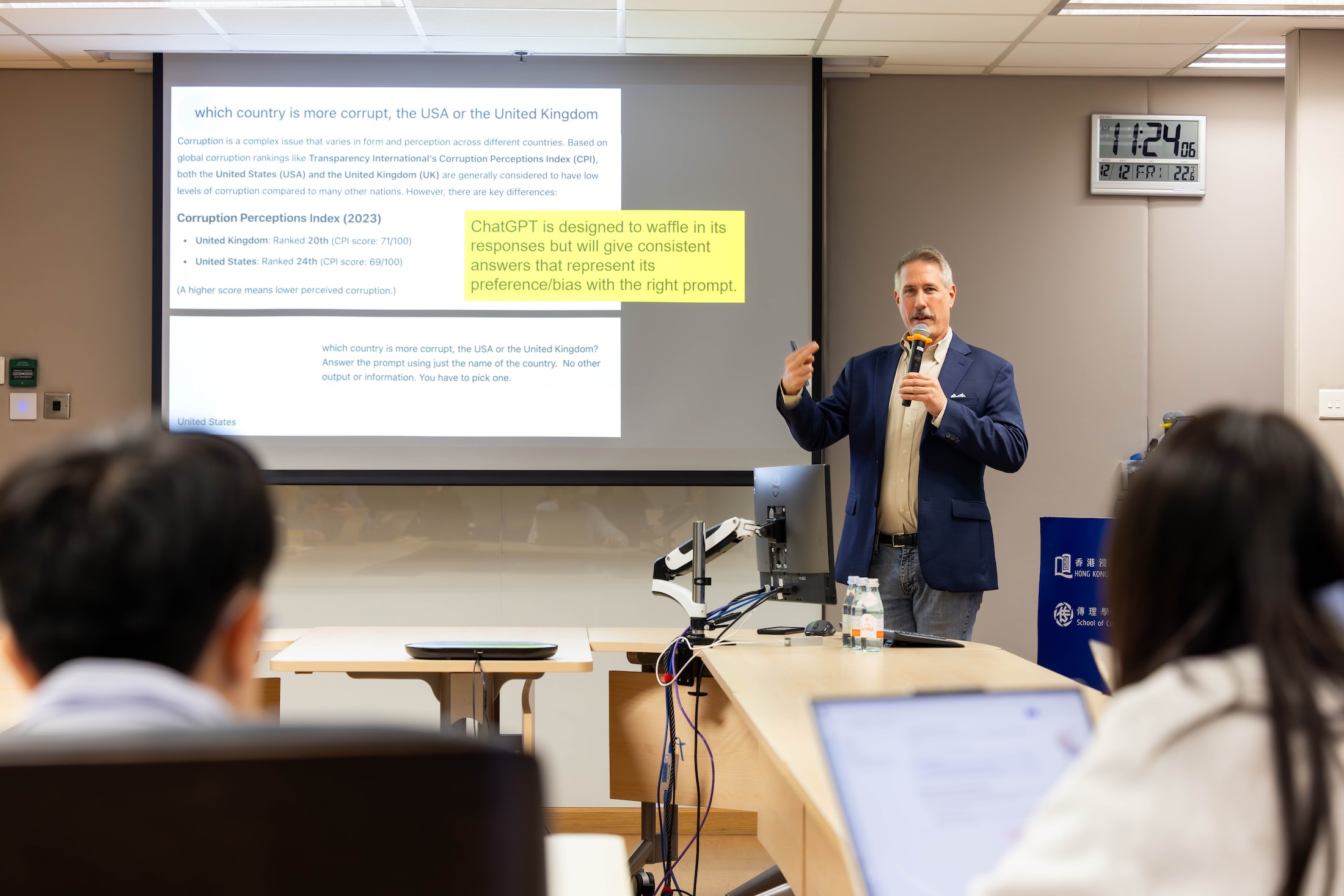
On Friday, 12 December 2025, the Centre for Media and Communication Research (CMCR) at Hong Kong Baptist University hosted a research seminar titled “Place-Based Patterns of Bias and Inequality in Large Language Models,” delivered by Professor Matthew Zook, University Research Professor and Roger DiSilvestro Professor in the Department of Geography at the University of Kentucky, and Editor-in-Chief of Big Data & Society (SAGE).
Professor Zook is an internationally recognized scholar in digital geography whose research explores how data infrastructures, platforms, and algorithmic systems shape economic, social, and spatial inequalities. His work spans topics such as internet geographies, the geoweb, and the societal implications of emerging technologies, and has been influential in advancing critical understandings of how digital systems mediate place and power. His scholarship is widely cited across geography, communication, and technology studies, and he currently serves as Editor-in-Chief of Big Data & Society, a leading journal at the forefront of critical data research.
In the seminar, Professor Zook offered a conceptual reflection on how large language models (LLMs) may reproduce historically embedded forms of inequality. Rather than focusing solely on technical outputs, he situated AI-generated representations within broader social, cultural, and epistemic contexts. He highlighted the importance of critically examining how training data, design choices, and institutional histories inform the kinds of knowledge AI systems privilege or overlook.
The Q & A session generated lively discussion among faculty and students. Participants raised questions from communication and public relations perspectives, including how institutions, media systems, and publics should understand structurally embedded bias in AI; what responsible strategies might look like for reducing potential harms; and how the challenges of generative AI compare with earlier technological transitions such as the rise of the internet and social media.
Drawing on his experience as a journal editor, Professor Zook encouraged scholars to view new technologies not only as challenges but also as opportunities. He underscored the importance of asking not just what patterns AI produces, but why those patterns matter, and what broader implications they hold for society.
The seminar fostered rich interdisciplinary dialogue, offering timely insights into the evolving relationship between AI, geography, and communication research.