News
CMCR Event Recap: Mediated Trust: From News Media to AI
20 Oct 2026
The Centre for Media and Communication Research (CMCR) at the School of Communication, Hong Kong Baptist University (HKBU), co-organised a research talk with the International Chinese Communication Association (ICCA) on 20 October 2026. Titled “Mediated Trust: From News Media to AI”, the event welcomed participants in person and online.
The talk featured Professor Terry Flew, Professor of Digital Communications and Culture at The University of Sydney and an Australian Research Council (ARC) Laureate Fellow. The session was hosted by Professor Vincent Huang, Assistant Professor at the School of Communication, HKBU, and Membership Chair of the ICCA.
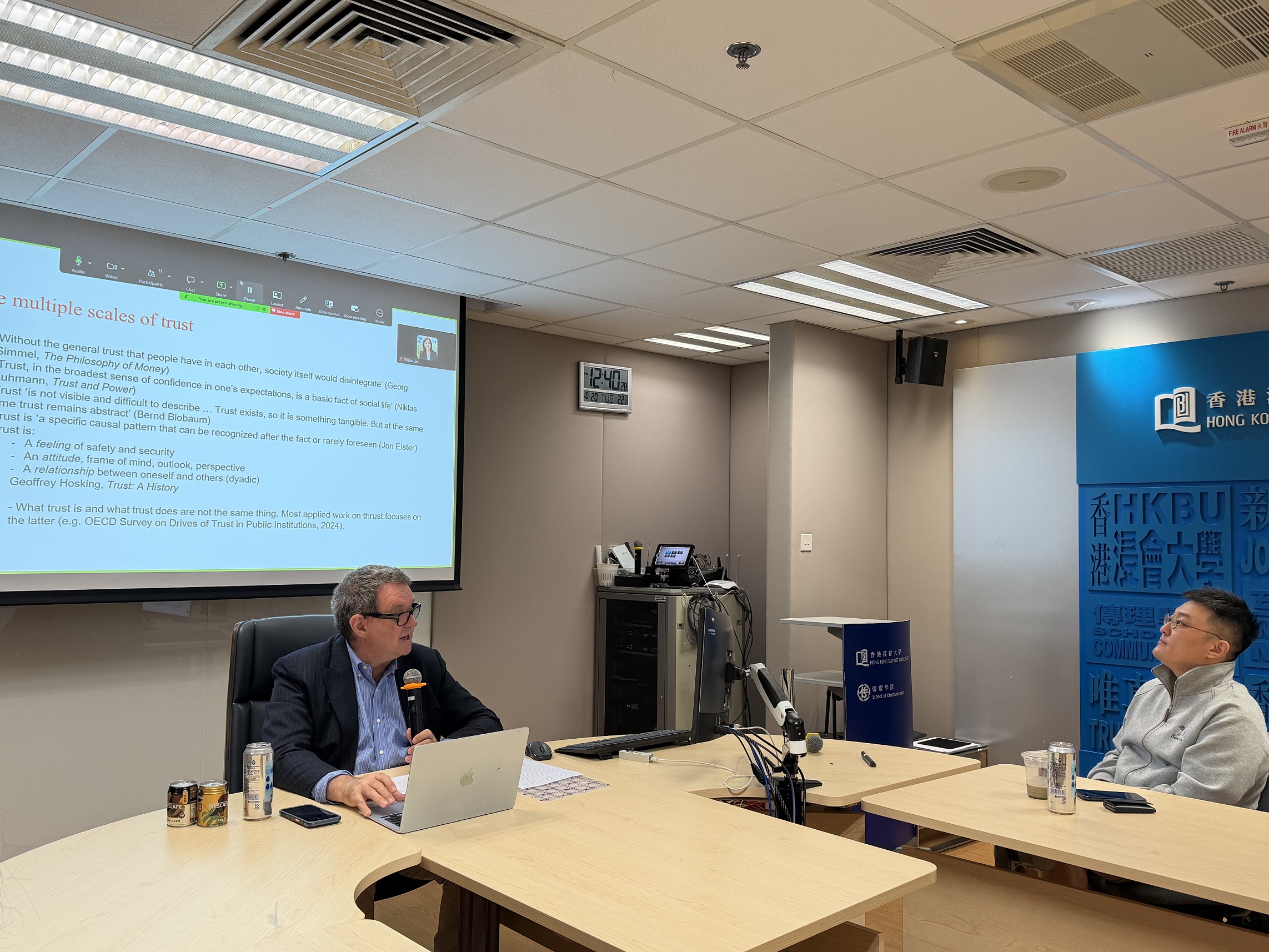
Drawing on his ongoing research, Professor Flew introduced a framework for understanding mediated trust and its implications for journalism and artificial intelligence.
Understanding Mediated Trust
Professor Flew emphasised that mediated trust is not the same as “trust in the media”. The concept addresses the formation of trust through communication, institutions, and technologies, which overlap and shape one another. He distinguished trust through technology from trust in technology itself.
He explained that trust enables cooperation under conditions of uncertainty and operates across three interconnected scales: interpersonal trust at the micro level, institutional trust at the meso level, and social trust at the macro level. Institutions occupy a central position in connecting individuals and groups with wider social systems.
Professor Flew also addressed the relationship between trust and truth. Factual accuracy alone does not secure public trust: how claims are communicated, and whether audiences perceive speakers as having their interests at heart, also matter.
Rethinking Trust in News Media
Amid concerns about misinformation and fake news, Professor Flew examined trust in an increasingly diverse and platformised news environment, where professional journalism coexists with alternative sources and online creators. He emphasised the need to consider which sources audiences trust and under what circumstances. He also highlighted a paradox: audiences may express distrust while continuing to rely on news in everyday life.
Debating Trustworthy AI
In the final section, Professor Flew outlined three competing positions on “trustworthy AI”. One critiques the term as an empty signifier that can enable corporate ethics washing. Another questions whether machines can be trustworthy given their lack of moral agency. A third, computational reliabilism, holds that consistent task performance can justify reliance on AI.

Professor Flew concluded by considering what AI means for communication research. AI systems increasingly generate messages, respond to users, and communicate with other systems. As technologies take on these communicative roles, they challenge the familiar understanding of communication as a human activity facilitated by media. This development raises questions about what it means to trust AI as a participant in communication.
The Q&A addressed the relationships among trust, credibility, and authenticity, AI’s role in journalism, and whether declining trust might reflect greater critical literacy. Professor Flew acknowledged that greater trust is not necessarily desirable and discussed the challenges of evaluating expertise. The discussion underscored the importance of rethinking trust as digital technologies reshape public communication.
