EVENTS
Call for Papers - International Conference on AI, Technology, and Emerging Media (16 -18 Oct 2026)
16 - 18 October 2026
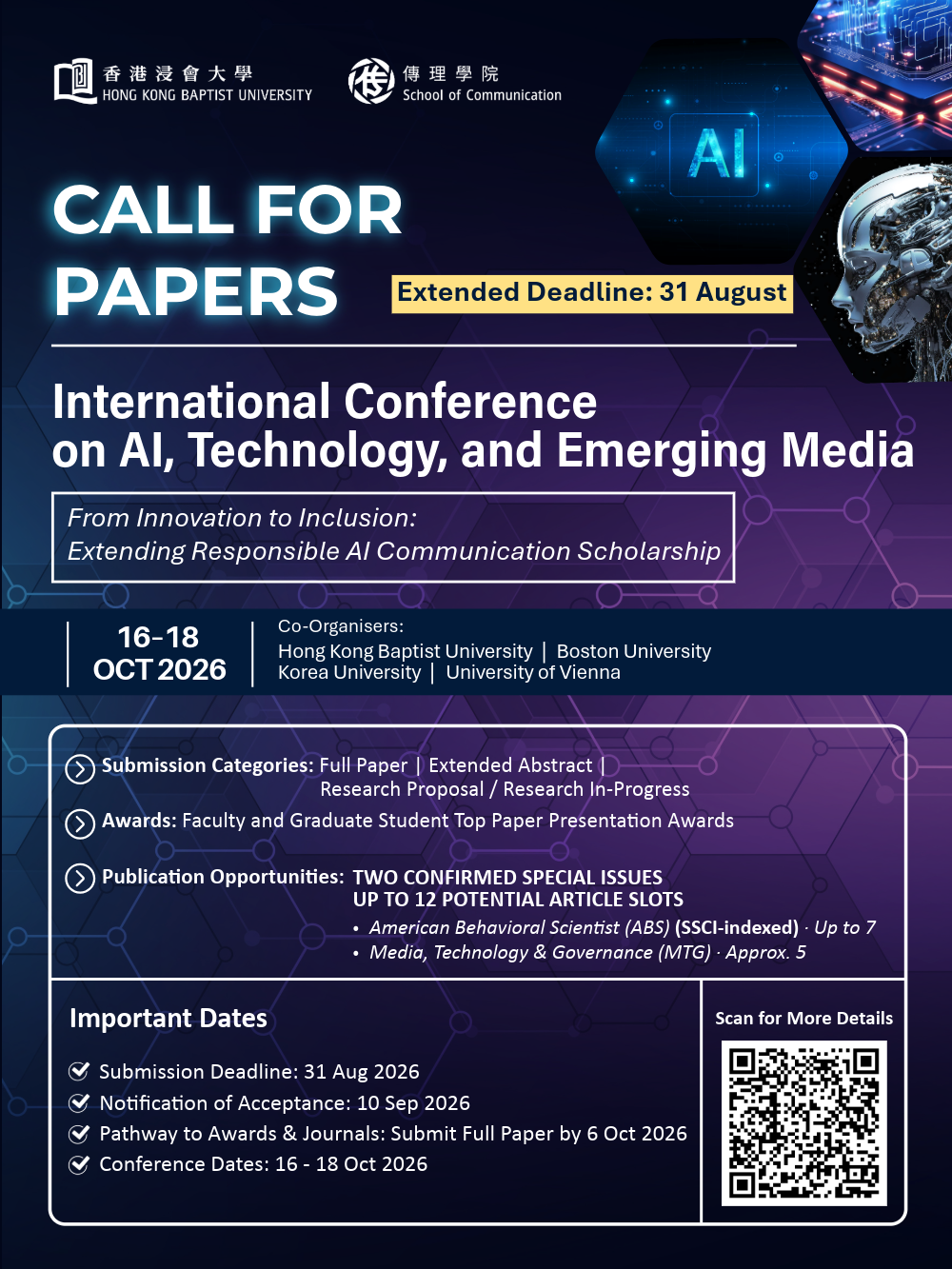
Call for Papers
International Conference on AI, Technology, and Emerging Media
2026 Annual Theme: From Innovation to Inclusion: Extending Responsible AI Communication Scholarship
16–18 October 2026
Host: Hong Kong Baptist University
TWO CONFIRMED SPECIAL ISSUES · UP TO 12 POTENTIAL ARTICLE SLOTS
- American Behavioral Scientist (SSCI-indexed) · Up to 7
- Media, Technology & Governance · Approx. 5
Hong Kong Baptist University, Boston University, Korea University, and the University of Vienna invite submissions for the inaugural International Conference on AI, Technology, and Emerging Media, jointly organized as part of a four-university effort to build a sustainable global research network on AI, communication, and emerging media.
As the first initiative of this international consortium, the 2026 conference will be hosted in Hong Kong, a global center of communication and a hub connecting East and West. The conference is intended to bring together faculty members, graduate students, and international scholars who are interested not only in presenting research but also in joining a longer-term academic initiative designed to foster sustained scholarly exchange, tangible research collaboration, publication opportunities, and future consortium-based engagement.
The annual theme, “From Innovation to Inclusion: Extending Responsible AI Communication Scholarship,” reflects the need to move discussions of AI beyond the promise of innovation alone and toward broader questions of fairness and shared social benefit. As AI increasingly shapes communication, institutions, and public life, the conference seeks to explore how communication scholarship can better address hidden inequalities, uneven adoption, and emerging forms of exclusion, while also helping to advance more socially beneficial and inclusive futures.
This conference is therefore designed to be more than a conventional research presentation venue. It will provide meaningful intellectual and professional takeaways through keynote sessions, panel dialogues, conference presentations, a research workshop, publication discussions, and opportunities for future collaboration across institutions and national contexts. We warmly invite researchers who are interested in this initiative and its broader collaborative vision to join us in Hong Kong for this inaugural conference.
Possible Topics Include, but Are Not Limited To:
- Responsible AI communication scholarship
- AI and public communication
- Fairness, inclusion, and adoption in AI-mediated communication
- AI governance and institutional responsibility
- AI, journalism, and emerging media
- AI and advertising / strategic communication / public relations
- Human-AI communication and authenticity
- AI, health, science, and risk communication
- Emerging inequalities and hidden exclusions in AI communication
- Global and cross-national perspectives on AI communication
- Communication research on socially beneficial AI
- Comparative and international approaches to AI, technology, and emerging media
Guiding Principles
This conference is guided by the following principles:
- Responsible AI communication scholarship must protect freedom of expression, academic freedom, and open access to information.
- Research on misinformation, harm, safety, and inclusion should not be used as a pretext for suppressing dissent, limiting legitimate controversy, or narrowing public debate.
- The conference welcomes critical inquiry into all forms of communicative power, including state power, corporate platform power, institutional power, and algorithmic power.
- Comparative research should examine how different political and media systems define “responsibility,” “harm,” “inclusion,” and “public interest,” rather than assuming that these terms have a single universal meaning.
- The conference supports methodological transparency, open debate, and the right of scholars to present findings that may be inconvenient to governments, corporations, universities, platforms, or other institutions.
Submission Categories
We welcome submissions from faculty members, postdoctoral researchers, and graduate students.
Authors may submit either
1. Full Paper
• Completed research paper
2. Extended Abstract
• Approximately 1,500 words
• Should include the research purpose or questions, theoretical framework, methods, key findings or preliminary results where available, and expected contributions or implications.
• Suitable for studies that are substantially developed but not yet prepared as a full manuscript.
3. Research Proposal / Research in Progress
• Approximately 500–1,000 words.
• May describe a planned or ongoing study for which data collection or analysis has not yet been completed.
• Should clearly present the research problem or questions, theoretical rationale, proposed or ongoing methods, and expected contribution.
• Authors are encouraged to use the conference as an opportunity to receive constructive feedback and further develop the project.
Awards
The conference will present:
• Graduate Student Top Paper Presentation Award
• Faculty Top Paper Presentation Award
Full papers submitted by the initial submission deadline will be eligible for conference paper awards.
Authors who initially submit an Extended Abstract or Research Proposal / Research in Progress may also become eligible for an award by submitting a complete full paper no later than 6 October 2026, ten days before the first day of the conference.
Publication Opportunity
Two special issue publication opportunities have been confirmed for selected full-paper submissions:
American Behavioral Scientist (ABS) (SSCI-indexed)
Special issue title: From Innovation to Inclusion: Responsible AI, Emerging Media, and the Social Future of Communication
Possible research article slots: Up to seven research articles.
Media, Technology & Governance (MTG)
Special issue title: AI Innovation, Communication, and Societal Impact
Possible research article slots: Approximately five research articles.
Eligibility and publication process
Authors who initially submit an Extended Abstract or Research Proposal / Research in Progress may remain eligible for special issue consideration if they submit a complete full paper by 6 October 2026.
Conference acceptance, submission of a full paper, or receipt of a conference award does not guarantee publication. Manuscripts invited for special issue consideration will undergo further development, independent peer review, and final editorial approval by the respective journal.
Originality Policy
The conference welcomes original work, work in progress, and research proposals. Work already published is not eligible for conference paper awards or special issue consideration.
A manuscript later submitted to an ABS or MTG special issue must comply with that journal’s originality and concurrent-submission policies and may not be under review elsewhere.
Graduate Student Accommodation Support
Graduate student presenters may receive accommodation support at an HKBU on-campus hotel. Accommodation will normally be provided in a shared room with another conference participant. If room availability is insufficient, accommodation support will be provided for one graduate student presenter per accepted submission. Applicants must be currently enrolled graduate students, have an accepted presentation, and attend the conference in person. Further details regarding accommodation arrangements will be provided after acceptance.
Important Dates
• Submission deadline: 31 August 2026
• Notification of acceptance: 10 September 2026
• Full-paper deadline for award and special issue eligibility: 6 October 2026
• Conference dates: 16–18 October 2026
Submission Information
Please complete the online submission form and upload both required manuscript files through the this link.
Authors must upload:
1. An anonymous manuscript with all identifying author information removed; and
2. A manuscript containing complete author details
Please submit one form for each manuscript.
Contact Information
For questions regarding submissions, conference participation, or accommodation support, please contact:
Professor Keonyoung Park (Assistant Professor, Hong Kong Baptist University)
Email: kepark@hkbu.edu.hk